


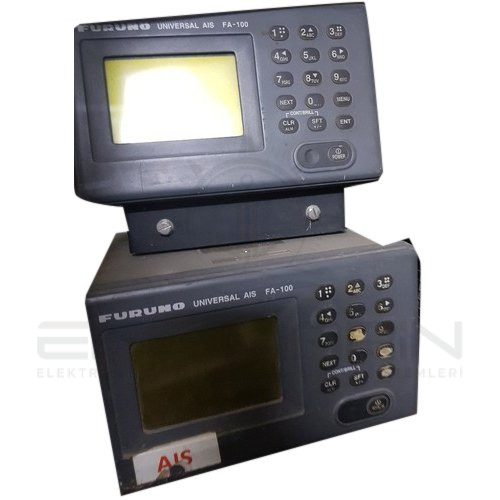
The FA-100 is a universal shipborne AIS capable of exchanging navigation and ship data between own ship and other ships or coastal stations. It complies with IMO MSC.74(69) Annex 3, A.694, ITU-R M.1371- 1 and DSC ITU-R M.825. It also complies with IEC 61993-2 (Type testing standard), IEC 60945 (EMC and environmental conditions).
Teklif FormuThe FA-100 consists of VHF/GPS antennas, a transponder unit and several associated units. The transponder contains a VHF transmitter, two TDMA receivers on two parallel VHF channels, a DSC channel 70 receiver, interface, communication processor, LCD display, and internal GPS receiver. The internal 12-channel all-in-view GPS receiver with a differential capability provides UTC reference for system synchronization to eliminate clash among a multiple users. It also gives position, COG and SOG when the external GPS fails. The LCD panel displays all required information about Static data, Dynamic data, Voyage related data and Short safety-related messages. The information and messages are automatically updated according to the ITU-R M.1371-1, e.g., static information every 6 min and on request, dynamic information every 10 s on ship faster than 3 kt and 3.3 s when changing course at 0-14 kt, etc. The AIS target symbols can be overlaid on the radar FAR-28x5 series (with RP-340), FR-21x5 series (with RP-250) and FR-15x5 series (with RP-180). The new RP radar plotting modules provide practically unlimited number of AIS targets together with ARPA symbols. Operational concept is common to all RP- modules. Place the cursor on an AIS target of interest and hit the AIS Data key, and the relevant data is visible on the data area below the ARPA data cell. If multiple AIS symbols mask the ARPA and radar picture, you can sleep the AIS targets. The triangle symbols get smaller for positive observation of ARPA symbols. The Automatic Identification System (AIS) was originally developed to aid the Vessel Traffic Services (VTS) by use of VHF transponder working on Digital Selective Call (DSC) at VHF Channel 70 and is still in use along the UK coastal areas and others. Afterward the IMO developed a Universal AIS using the new sophisticated technology called Self-Organized Time Division Multiple Access (SOTDMA) based on a VHF Data Link (VDL). This system is synchronized with GPS time to avoid conflict among multiple users (IMO minimum 2000 reports per minute and IEC requires 4500 reports on two channels). The system operates in 3 modes - autonomous (continuous operation in all areas), assigned (data transmission interval remotely controlled by authority in traffic monitoring service) and polled (in response to interrogation from a ship or authority). The VHF channels 87B and 88B are commonly used and in addition there are local AIS frequencies. The shipborne AIS transponders exchange various data as specified by the IMO and ITU on either frequency automatically set up by the frequency management telecommand received by the DSC receiver on ship. VHF transmit power is also set up for 12.5 W or 2 W automatically.